
Where Young Voters Can Decide Elections in 2026
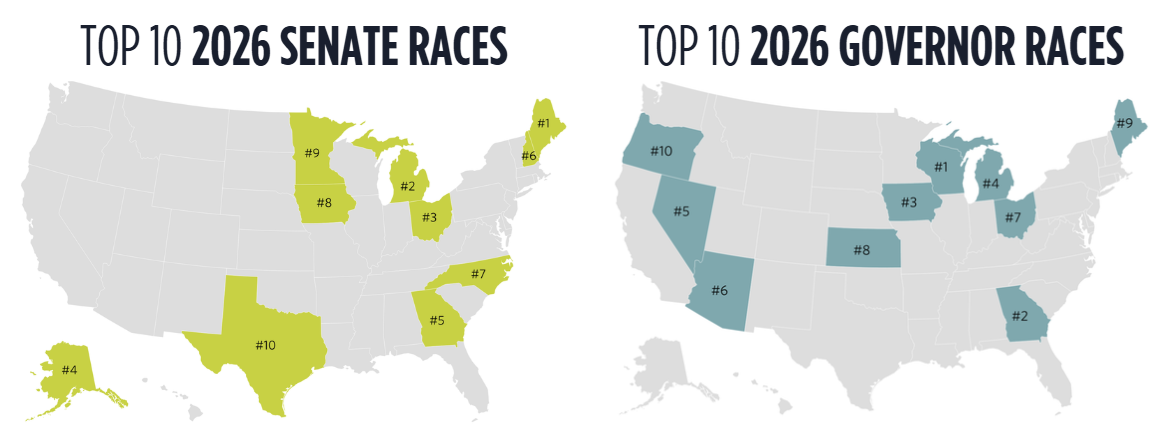
Note: The 2026 Senate and Governor YESI rankings were updated on July 24 to reflect new data on electoral competitiveness.
Young voters are a large and powerful segment of the electorate that can have a major impact on the 2026 midterms. Close to 50 million youth, ages 18-29, are eligible to cast ballots, including more than 8 million newly eligible voters since the 2024 election. These young people can cast critical swing votes and shape electoral outcomes in races across the country.
To quantify young voters’ political power, CIRCLE’s Youth Electoral Significance Index (YESI) ranks the elections where young people have the highest likelihood of decisive impact on election results. The YESI combines more than a dozen indicators of youth demographics, past voting history, community context, and electoral competitiveness to produce rigorous data-based rankings. We share the top 10 gubernatorial, U.S. Senate, and U.S. House races below.
The YESI rankings are not predictions of youth voter turnout or of specific election results. They measure the potential for young people to play a meaningful role in deciding key races, but that potential can only be fulfilled if candidates, campaigns, organizations, and other advocates invest in outreach and create meaningful opportunities for youth engagement in elections.
Explore the rankings and read more about the youth vote in each race below. Read more about the YESI methodology here.
Read More about States in Senate and Governor Rankings
Maine is one of the “oldest” states in the country: it has a relatively low share of young residents. But the youth who do live there are highly engaged: the state frequently has above-average youth electoral participation—including the second-highest youth voter turnout (60%) in 2024. Maine has all of the facilitative election laws we track and no voter ID requirement. Its demographic and socioeconomic characteristics are linked to higher potential for civic participation.
- In a race that has garnered major national attention, Democrats are hoping to unseat long-time Republican Senator Susan Collins. In Collins’ last race in 2020, young people were the only age group that supported her Democratic challenger—by more than 20 points
- The Maine gubernatorial race for an open seat is expected to be highly competitive. Except for when the same candidate has been reelected, the state has not elected governors from the same party in consecutive elections since the 1950s.
Michigan has become one of the country’s most important battleground states. Our 2024 Youth Electoral Significance Index ranked it #1 in the U.S. presidential race, and in 2026, it claims the top spots in both our U.S. Senate and gubernatorial rankings. Michigan has also become one of the top states for youth voting: the state had the highest youth turnout rate in the country (37%) in 2022, and the third-highest (58%) in 2024. The state now has a full complement of facilitative election laws—online, same-day, automatic, and pre-registration—that can make it easier for youth to register and vote.
- In a closely watched U.S. Senate race for an open seat, several high-profile Democratic candidates are vying for the nomination to face Republican Mike Rogers, who very narrowly lost his 2024 bid for Michigan’s other Senate seat.
- The Michigan gubernatorial race is also for an open seat; Democratic Secretary of State Jocelyn Benson and Republican U.S. Representative John James are their parties’ respective nominees.
Ohio’s two competitive statewide elections drive significant potential for youth impact in the 2026 midterms. Some of the state’s population demographics are conducive to high voter turnout, but that potential has not always been fulfilled: the state has had average—or lower—youth voter turnout in recent election cycles. Ohio has few facilitative election laws that make registration easier and require a photo ID for voting. The state does rank very highly in our measure of nonprofits focused on youth, which can bolster opportunities to overcome some of these challenges.
- There will be a highly contested U.S. Senate race between incumbent Republican Jon Husted, who was appointed to the seat after J.D. Vance assumed the Vice Presidency, and former four-term Democratic Senator Sherrod Brown, who lost the state’s other Senate seat in 2024.
- In the race for Ohio’s open gubernatorial seat, former Republican presidential candidate Vivek Ramaswamy faces Democrat Amy Acton. In the state’s most recent election for Governor, young people were the only age group that voted for the Democratic candidate.
There are major opportunities and challenges for youth electoral engagement in Georgia. The state has one of the “youngest” populations in the country; citizens under age 30 make up a high share of residents. Georgia youth turnout rates have been above-average in recent election cycles, and large shares of Black and Latino youth can play a critical role—but require targeted outreach to overcome historically lower participation rates. A strong educational and nonprofit ecosystem can help provide key support for youth engagement
- Democrat Jon Ossoff is seeking reelection to the U.S. Senate. Young voters, especially Black youth, were key to his election in 2020.
- There is a competitive race to succeed Georgia Governor Brian Kemp in a state that currently has two Democratic U.S. Senators but has elected Republican governors since 2002.
Young Iowa voters have consistently had above average youth voter turnout in recent elections, and their vote may be up for grabs. After supporting Democratic candidates in past cycles, AP VoteCast data suggests that youth in the state supported President Trump by a wide margin in the 2024 presidential election. Iowa has a high rates of investment in higher education and in nonprofits per capita—two types of institutions that can support youth in a state where election laws are a mixed bag (e.g., same-day registration but a voter ID law.)
- The Iowa gubernatorial race is for an open seat. The presumptive Democratic nominee, Rob Sand, was the only Iowa Democrat who won a statewide office in 2022.
- There is also an open race for the U.S. Senate in Iowa, where Sen. Joni Ernst declined to seek a third term.
Read More about States in the Senate Rankings
The youth vote can have significant impact on the U.S. Senate race in Alaska, which has one of the youngest populations in the country. The state has a high rate of nonprofits per capita but few are explicitly focused on young people, which points to potential for organizations to incorporate youth outreach and programming into their efforts. The youth vote in the state is competitive: according to AP VoteCast data, in 2024, young people in Alaska split their votes almost evenly between former Vice President Harris and President Trump. In 2026, former U.S. Representative Mary Peltola is challenging incumbent Republican Senator Dan Sullivan.
New Hampshire is home to a relatively low percentage of young people—but has the highest percentage of residents enrolled in a higher education institution of any state in the country. The socioeconomic characteristics of New Hampshire’s population, like unemployment rate and median household income, are also conducive to high potential turnout. But youth need support to register and vote. New Hampshire has very few facilitative election laws; for example, it is one of a handful of states in the country without online voter registration. Young people in the state can make different choices at the ballot box than older voters: in the 2022 midterms, youth (ages 18-29) backed the Democratic U.S. Senate candidate by over 50 points, and they were the only age group to support the Democratic candidate for governor.
Youth under age 30 make up more than 1 in 5 residents of North Carolina, and young voters in the state have had above-average turnout in recent elections—including 55% in 2024. The state, which is home to many major universities, also ranks highly in educational investment. That can create opportunities for students to register and vote, especially in a state with pre-registration for 16-year-olds. The last two U.S. Senate elections in North Carolina have been decided by less than 4 percentage points, and the 2026 race for an open seat is expected to be highly competitive.
Minnesota has led the nation in youth voter turnout in two recent elections (2018 and 2024), and was top-three in two others (2020 and 2022). That strong tradition of youth civic engagement is supported by some of the best voting policies in the country: the state earns our highest score for facilitative election laws. As the site of major protests in early 2026, Minnesota also has the potential to draw on the energy and organizing capacity built during those moments and channel them toward youth electoral engagement. There is an open race to fill the seat being vacated by Democratic Senator Tina Smith, who won the youth vote by 26 points when she was elected in 2020.
Texas is one of the youngest states in the country, with a well-above-average 23% share of its population under age 30. That means millions of young potential voters can have an impact on the 2026 U.S. Senate race, and there are hundreds of colleges and other institutions in Texas that can potentially support their engagement. That support is needed in one of the states where it’s hardest to register and vote: Texas does not have online, automatic, same-day, or pre-registration—and it has a strict voter ID law. Its diverse population includes large communities that have historically had lower electoral engagement. And overall youth turnout in the state has been below-average in recent elections, which underscores how much work is needed to capitalize on young people’s political potential.
Read More about States in the Governor Rankings
A perennial battleground state, Wisconsin is expected to have one of the most competitive gubernatorial races in 2026. Mandela Barnes, the favorite in the Democratic primary field, received 70% of the youth vote when he ran for U.S. Senate in 2022. However, Wisconsin is one of many states where the youth vote swung significantly toward President Trump in 2024 compared to 2020. While we do not have reliable youth turnout data for Wisconsin, the state’s demographic and socioeconomic characteristics are statistically associated with high voter participation.
Like neighboring Arizona, some aspects of Nevada’s demographic and socioeconomic characteristics (e.g., high Latino population) can be associated with low participation. However, unlike Arizona, Nevada has made it much easier for residents to register and vote: for example, the state has automatic and same-day registration and mails ballots to all registered voters. Nevada had above-average youth voter turnout in 2022 and 2024. In the 2022 cycle, when incumbent Republican governor Joe Lombardo won his race by less than 2 percentage points, young voters favored his Democratic opponent by 30 points.
Arizona can be a challenging state for youth voter engagement, but there is enormous potential for young people to have electoral impact. Youth turnout in the state has been about average in recent elections, and Arizona lacks many of the policies (automatic, same-day, and pre-registration) that can make it easier to participate. Latinos make up a high percentage of the state’s electorate, and young Latinos have had low voter turnout in recent elections. Incumbent Governor Katie Hobbs is running for reelection; she won her 2022 race by less than 1 percentage point. In that election, 70% of youth in the state voted for Hobbs.
Kansas has a relatively high youth share of its population and makes strong investments in both K-12 and higher education. However, it lacks most facilitative election laws and youth voter turnout in the state has been below average in recent election cycles. The 2026 gubernatorial race, for an open seat, is expected to be competitive. The state has had a Democratic governor since 2019 but President Trump won the state—and the youth vote, according to AP VoteCast—by significant margins in 2024.
Oregon has had above-average youth voter turnout in every election going back to 2014. It is one of the easiest states in the country for young people to register and vote: it has strong facilitative election laws and holds all-mail elections, which CIRCLE research has linked to increased youth participation. The state’s demographic and socioeconomic profile is also linked to high voter propensity, and it has a high share of nonprofits. Oregon’s most recent gubernatorial election was relatively close: it was decided by less than 4 percentage points.
Read More About the Congressional District Rankings
The Michigan 7th, which is centered on Lansing and includes parts of central and Southern Michigan, was the top-ranked YESI district in 2024 and takes the top spot again for the 2026 midterms. Youth under age 30 make up over 22% of the state’s population and there is a relatively large percentage of college students—the district is home to Michigan State University and other colleges. The district’s demographics are conducive to high turnout, there is a strong nonprofit sector focused on youth, and Michigan’s facilitative election laws have helped the state have high youth voting rates in recent elections.The district flipped parties in both 2022 and 2024.
The New Jersey 7th, in the northwestern part of the state, includes all of Hunterdon and Warren counties. While it has a relatively low share of youth in its population, it has one of the highest median household incomes of any district in the country and a high rate of nonprofits per capita that can potentially support youth outreach and engagement. Statewide, New Jersey had the highest youth voter turnout rate in the country in 2020 and above-average youth participation in 2024.
The Virginia 2nd district encompasses part of the Hampton Roads region in the southeastern part of the state, including Virginia Beach. The district is relatively affluent and its demographic composition is associated with high participation. Virginia had above-average youth voter turnout in the 2024 election; it has a strong suite of facilitative laws, like pre-registration and same-day registration, that can help youth participate. The last two VA-2 elections have been highly competitive: both were decided by less than 4 percentage points.
The Iowa 1st is in the southeastern part of the state bordering Illinois and Missouri. The district had one of the tightest races in 2024: the Republican incumbent was reelected by 0.2 percent—less than 1,000 votes. Statewide youth turnout in Iowa was above average in 2024 and in the previous midterms in 2022. More than 1 in 5 district residents are under age 30; the Iowa 1st is home to the University of Iowa. Nonprofits have a strong presence in the Iowa 1st and could support youth outreach in a state without automatic or pre-registration.
The Colorado 8th, north of Denver, includes cities like Brighton, Greeley, and Thornton. The district, created after the 2020 census, has been hypercompetitive: its 2022 and 2024 elections were decided by less than 1 percentage point, and it flipped parties in the most recent election. As such, CO-8 has been in the top five of our YESI district rankings for three straight cycles. Young people make up 23% of the district’s residents—which is well above-average. And Colorado is a perennially high youth turnout state with some of the best facilitative election laws in the country.
The Wisconsin 3rd, in the southeastern part of the state, includes cities like Eau Claire and La Crosse as well as exurbs of Minneapolist-St.Paul. The district has a large share of youth and enrolled students; it is home to multiple University of Wisconsin campuses. WI-3 also has a strong nonprofit sector focused on young people. The Republican incumbent won a close race in 2024 after a Democrat had represented the district for 26 years.
The Pennsylvania 10th is centered on Harrisburg in the southern part of the state. Youth make up 19% of district residents, and PA-10 is home to a number of colleges and universities including several Penn State campuses. Pennsylvania had one of the highest youth voter turnout rates in the country in the most recent midterm election and again in 2024; policies like automatic voter registration can help reach young voters. The 2024 election was exceedingly close: the incumbent Republican won by approximately 5,000 votes, or 1% of all ballots cast.
The Pennsylvania 7th, in the eastern part of the state bordering New Jersey, includes Carbon, Lehigh, and Northampton Counties. Nineteen percent of its residents are young, but it has a more diverse and higher immigrant population, which can present challenges for electoral engagement. It does have a relatively high share of residents enrolled in colleges like Lehigh University and a number of other higher education institutions. The state’s strong recent history of high youth voter turnout suggests there are structures in place that can support strong youth turnout. The district flipped parties in a close 2024 race decided by half a percentage point.
The Arizona 1st, which was redrawn in 2023, covers northeastern Maricopa County—including northeast Phoenix and Scottsdale. The current Republican congressman won a close 2024 race by less than 4 percentage points but is now running for governor, so the 2026 election is for an open seat. The district has a relatively low share of youth (17%) but resources to support them: a very high median household income and a strong nonprofit ecosystem. There is an important role for that support system: Arizona lacks most facilitative election laws and its youth turnout has been average in recent elections.
The Arizona 6th stretches from the suburbs of Tucson to the southeastern corner of the state, bordering New Mexico and parts of the U.S.-Mexico border. A diverse, immigrant-heavy district, 17% of AZ-6 residents are youth. The district has been represented by Republicans since 1995, but the last two elections in the district (2022 and 2024) have been decided by less than 2.5 percentage points. Arizona does not have pre-registration, automatic registration, or same-day registration, which makes it critical to invest in reaching and registering youth in the district.
YESI Top 50 House Districts
Beyond the top 10 House races described above, there are many districts where young people can have a major impact in the 2026 midterms. We share the top 50 YESI House races below:
